The essay was originally published in my mother tongue HERE. This version is an AI-assisted translation into English.
At the tenth edition of the World Robot Conference, held in August 2025 in Beijing, the spotlight was stolen by the dance choreography of five LimX Oli humanoid robots created by the Chinese company LimX Dynamics. Their synchronised and unusually fluid movements were still far from the supple and well-rehearsed body of a professional dancer who has left the best years of their life in front of mirrors in the sweaty halls of dance studios. Yet, they would undoubtedly put all of us hobbyists to shame – those of us who, after countless hours of salsa, bachata, zumba, or lindy hop, still look as if we’re in the early stages of a stroke when trying to follow the rhythm spontaneously. Not to mention the weekend R’n’B head-bouncers who seem determined to prove urbi et orbi that their neck muscles are the only functioning part of their body.
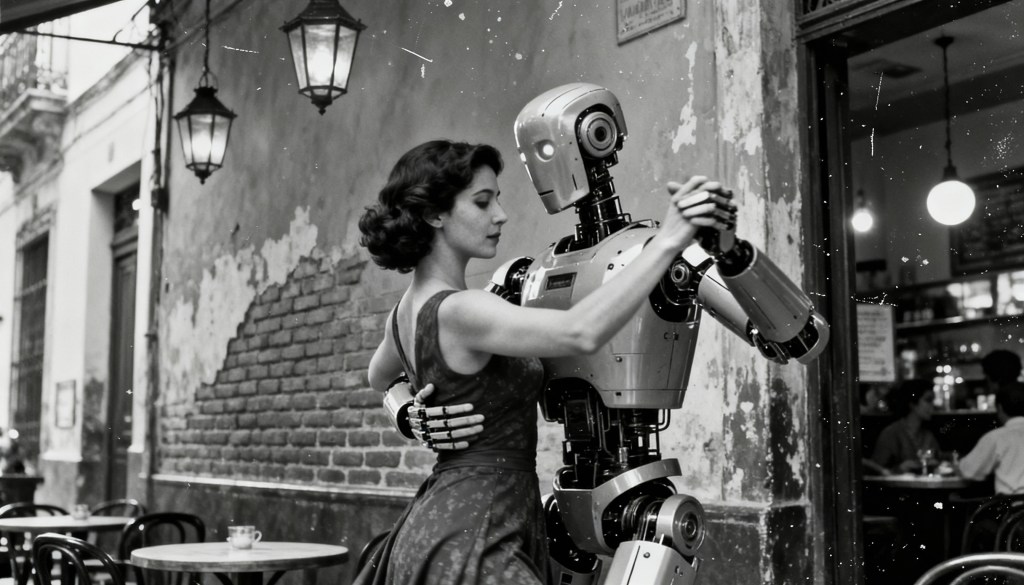
And while this robo-choreography might first cause concern among K-pop groups – whose members could easily be replaced by such android troupes – it’s not hard to imagine future generations of LimX Oli robots, or similar humanoid androids, in a tango embrace. From today’s perspective, it would, in fact, be extremely naive to dismiss such a possibility or scenario.
Thanks to the rapid development of artificial intelligence, mechanically more sophisticated humanoid robots could, in the foreseeable future, enter the tango embrace and harness their neural networks to learn from each tanda about the wide spectrum of postures, the variations of subtle communication of intention, and the energies and forces that govern the biomechanics of the Two. Each tanda would be translated into data and uploaded to a central cloud server from which, in real time, all other humanoid robots of the same brand would learn and continuously refine their technique and tango communication.
A humanoid robot would thus be able not only to achieve astonishing technical precision, and to master the (admittedly limited) vocabulary of tango movements, but also to read and respond to subtleties that the average tanguero or tanguera could not so efficiently perceive or distinguish. Such a humanoid tango android could learn all of this incredibly quickly, without the need for years of study, frustration, social awkwardness, and despair – without workshops or private lessons.
It is not impossible to imagine that, in the not-so-distant future, tango organisers – often drawn to kitsch and the spirit of spectacle – might be tempted to bring the first capable androids to tango events, whether as taxi dancers or as a more profitable kind of couple for a sensationalist tango performance.
However, would an abrazo with an android still be tango? Or would we, in that embrace, inevitably lose tango itself?
The Unbearable Banality of Complicated
At a session on complexity theory I attended a few years ago, the lecturer presented two images: one of an aircraft cockpit’s instrument panel, and another of a plate of spaghetti served solo. The question was: which of the two represents complexity, and which represents the complicated? Take a moment to think about it.
The array of countless levers, buttons, switches, screws, and gauges from the cockpit – although capable, at first glance, of triggering serious hyperventilation or a panic attack – is merely an example of a complicated system. Every command has a clear function and a precisely defined relationship with the others, leading to a predetermined and accurate outcome – assuming, of course, that the mechanism isn’t faulty! The pilot knows exactly what to expect when using a given control. In other words, the result of activating any particular command is entirely predictable. There is a clear engineering logic, physical laws, and refined causality in the aircraft’s control system.
This does not mean that piloting an aircraft is simple – far from it – but it does mean that, with sufficient effort, one can fully master the instrument panel, understand the system’s logic, and know exactly what to expect when pressing a button or pulling a lever.
Spaghetti, on the other hand, is an example of complexity. The way the strands intertwine on the plate and settle when served remains elusive – it cannot be reduced to a simple pattern. Serve the same amount of cooked spaghetti – from the same manufacturer, boiled for the same length of time – with the same tongs, onto the same plate, in the same way, and their arrangement will be different each time. Not only does the serving of spaghetti defy predictability, but it’s practically impossible to “capture” and describe its internal pattern.
Whereas each function on a cockpit dashboard could be explained in a manual, or even described and taught over the phone to someone who’s never seen it, anyone attempting to convey accurately the shape and interrelations of spaghetti on a plate would find themselves in serious trouble. While a person on the other end of the phone could, with precise instructions, draw a fairly accurate diagram of the cockpit controls and even label each button’s purpose, they would never be able to reproduce the plate of spaghetti, no matter how detailed the description. Nor could they record a set of instructions for how to serve an identical plate. And yet, we’d all agree that mastering the art of cooking and serving spaghetti is incomparably easier than mastering the tangled jungle of cockpit functions.
Tango is both complicated and complex. But it’s not the complicated side that draws us into the world of tango, makes us dance it, or keeps us there. The complicated part of tango is something we overcome, so that we may embark – as prepared and as competent as possible – on an expedition toward its unmasterable complexity.
Tango technique is complicated. Understanding one’s own body, posture, and the specific positioning of bodily elements in order to achieve the desired outcome – whether in sending or receiving intention through connection with another person – is a difficult, painstaking, and lengthy process. Reprogramming physical habits requires the building of “muscle memory,” which delays the moment when knowledge becomes physically operational.
The whole thing is further complicated by the existence of numerous different technical systems, since tango, fortunately, is not a standardised dance and therefore not subject to the judgement of “right” and “wrong.” Instead, we seek what works – primarily for ourselves. Each dialect of tango technique has its limits and potential for misunderstanding, especially when we’re dancing with someone unfamiliar with that dialect, or who simply dislikes it. Every “truth” of tango technique is, to a greater or lesser extent, confined to its own system (its dialect) and often has an equally valid and successful “counter-truth” in another.
The ultimate truth about proper, upright posture, for instance, will be quickly shaken when you see an excellent tango dancer who spends the entire dance slightly hunched and looking at the floor, all the while losing nothing of their cabeceo desirability or dance virtuosity. There’s no shortage of similar examples.
Tango is also dynamic and constantly evolving – through encounters with other dances, demographic groups, subcultures, and social trends – which further complicates the universe of tango technique. Ultimately, bodies differ, and formulaic tango recipes often need revision and adaptation for atypical physical builds; biomechanics are not universal, as every tall leader, every person with scoliosis, or anyone whose body diverges from the corporeal reference assumed by most instructors quickly realises.
And while mastering the biomechanics of tango is complicated, its complexity lies elsewhere: in the uncertainty of relationships, in the fluctuations of body-mind, in unstable and sometimes elusive emotions, in the (often uncomfortable) self-discovery and revelation-to-oneself it provokes, and in those fissures where we cease to be sure whether we’re living the fullest version of ourselves or have simply drifted into something entirely alien to the Being of our everyday life.
While the technique of tango dancing can, with hard work and dedication, be relatively mastered, the dynamics of tango dancing – or living – is not a to-be-resolved formula. Dance the same tanda twice with the same person, in the same space, wearing the same clothes and shoes, at the same time of day – and it would not be unusual for the experience to be entirely, perhaps even diametrically, different. Or spend years attending the same festival, meeting the same people, and yet each time, everything changes, starting with ourselves (and it would be a truly tragic circumstance if it didn’t).
Like the aforementioned spaghetti, we never know how tango will arrange us – into what elusive inner dynamic, within ourselves, within the ronda, or within the community, we will find or lose ourselves. Anger, disappointment, fear, nostalgia, elation, jealousy, desire, lust, melancholy, alienation, confusion, and other emotions and states hover low in the heavy air of the milonga, pressing heavily on the chests of those unaccustomed to its somewhat aggressive cacophony of energies.
There is no demon that does not hover above the rondas and their edges. For demons, the milonga is a three-Michelin-star feast. But just as smoke signals the presence of fire, so too do demons indicate the presence of life. Where there are demons, there is life. And the milonga, to them, is like a lollipop to ants. Demons don’t give a single fuck about ChatGPT.
Tango is “human, all too human”
In a distant future, the inhabitants of the One State – built largely of glass in the name of transparency (read: surveillance) – live in a perfectly harmonious world governed by mathematical principles and the dictates of reason. The dynamics of life in the One State are scientifically optimised, with a clear timetable of activities; the “Numbers” (citizens of the One State) conform to their assigned roles, and emotions are regarded as relics of a primitive human past. Dreams are classified as mental illness, and free will is considered a laughing matter – an incomprehensible defect of the archaic person. Sexual relations are guided by principles of scientific rationality and may only occur upon prior submission of a formal request. The Numbers are protected from encounters with the wild, primitive nature by a great Green Wall surrounding them, and any incidents of natural impulses emerging within the walls are prevented by the secret police who maintain constant surveillance.
Those who have not recognised where the world from the previous paragraph comes from might guess that it is a grandiose vision of one of today’s tech lords from Silicon Valley, in the throes of microdosing LSD or general delusion; or perhaps the wet dream of a technocrat who believes that utopia lies only a few regulatory packages and a handful of data and statistical models away; or perhaps the ultimate outcome of a world advocated by some progressive movement that seeks humanity’s salvation in nothing other than all-pervading prohibitions, proceduralisation of life, and the surveillance of public and private speech. (Oh heavens, what obscure times we live in: I had to go back several times to the start of the previous paragraph, because it feels so wrong to write “in a distant future” when the rest of the paragraph seems to describe the very world we are now bringing into life through the ergonomic keystrokes of our delicate 13-inch laptops and the less ergonomic screens of our phones with non-removable batteries.)
Some, however, have recognised that the described “future” comes from Zamyatin’s novel We, the pioneering book of the modern dystopian genre. In that world of the One State, the chief engineer of the spaceship Integral – the ship that is to spread the brave new world throughout the cosmos – D-503 keeps a diary in which he reports on his reality and his own reflections. His exemplary, proceduralised, and predictable life is thrown off balance by an encounter with I-330, a reminiscence of the “outdated” (wo)man of the deluded past: she flirts openly and enjoys sexual relations without prior application, that is, without the consent of the State, indulging in vices and irrational sensual pleasures. At the beginning of their encounter, D-503 feels discomfort and disgust toward the primitive distinctiveness and improper – that is, illegal – behaviour of I-330, yet soon finds himself in a state of agonising obsession and fascination with her, which he compares in his diary to an illness of the primitive, outdated man. In a story without a Hollywood happy ending (as is the case with every quality work of literature), D-503 is ultimately “saved” from his complexity and reprogrammed into a Number, while I-330 is executed. Still, in the episodes between their meeting and the (unhappy) end, the rebel organisation Mephi, into which I-330 draws D-503, manages to partially demolish the Green Wall and, in their failed revolution against the One State, at least bring once again into contact the world of Numbers and the world of Nature – that is, the walled world of cold hyper-rationality and the colourful world of unproceduralised nature.
Can we imagine the Numbers dancing tango? Can we imagine D-503 as a milonguero? Hell no! How could one dance tango in a world of complete predictability, a world based on scientific rationality? How could one experience a warm abrazo in a world “emancipated” from emotion? How could one, in a world “saved” from the untamed dark realm of human affects, make a pause and feel the heartbeat or the broken breath of one’s partner to the music of:
¡Arrésteme, sargento,
y póngame cadenas!…
¡Si soy un delincuente,
que me perdone Dios!
Yo he sido un criollo gueno,
me llamo Alberto Arenas.
¡Señor… me traicionaban,
y los maté a los dos!
Mi china fue malvada,
mi amigo era un sotreta;
cuando me fui a otro pago
me basureó la infiel.
Las pruebas de la infamia
las traigo en la maleta:
¡las trenzas de mi china
y el corazón de él!
Why would a world of happy sterility and absolute order even need tango? With what inner longing would the bandoneon of Domingo Federico converse? With what Absence? Perhaps with that crack which, for a moment, opened within D-503 and led him into the agony of animal life before he hastily threw himself back into the safe abrazo of the Benefactor1.
Can we then imagine that tango evokes something “all too human” in mechanised beings of cold rationality – that it usurps the comfort of predictability and pushes the Numbers of the present and future into the uncomfortable abrazo of human complexity? Oh yes! And many of us who dance tango have probably borne witness to that moment of being startled from the alienated routine into the human complexity.
Zamyatin’s Numbers are the ultimate expression of the concept of (wo)man we have nurtured for centuries – not a wrong turn we might accidentally take, but a highway we speed along toward a lofty tomorrow. For centuries we have raised rational thought onto the pedestal of humanity, seeing it as the ultimate and most exalted expression of what is special in a Human – what saves us from slipping into the dangerous idea of comparison with the rest of living nature. Rational Mind is the bastion that protects us from blending with the “lower” world of animals (like the Green Wall), the human quality that makes us superior – and, by the perverse logic, gives us the right to dominate “unthinking” life. From Descartes’ cogito ergo sum – which he “proved” empirically, among other ways, by dissecting live animals whose agonised cries and convulsions served to demonstrate that animals were not conscious, thinking, beings but mere mechanical automata (bête-machine) – to modern overheated scientism – which wears down the servers of social networks in its indignation over unscientific tweets, warns us of the scandalous fact that people in pubs discuss current issues without proper scientific references, and ultimately calls for censorship and cancellation of the threatening freedom of speech of the unscientific humans – we have lived through the evolution of reducing man to a function of rational, exact thought.
In this “development”, not only was the merciless exploitation of the non-human living world and, generally, of nature justified by the idea that our Reason makes us the superior centre of the universe, but the same argument was used to legitimise ruthless colonial expansion, racial and gender segregation – where the narrative of Others as people with less Cogito once went so far as to “scientifically prove” that certain groups of people were not biologically predisposed to think as much as others. Those Others often indulged in primitive “animal” activities such as ritual, unproceduralised sensuality, uncanonised music, and untamed dance. Those Others “bent their knees” and entered the warm, non-marital (often homoerotic) embrace of something that would grow into tango – something whose animalism would at first disgust the Reason of both Argentine and European blue blood and the educated petty bourgeoisie, only for them, decades later, to discover within it the vastness and depth of an excursion, an escape, or an exile into the human2. But let us return from the expanding digression of this paragraph.
The direction of social evolution charted by Descartes in the 17th century – accelerated by the sequence of industrial revolutions which, from the 18th century onwards, raised humans into pragmatic, executive, mathematised, and ever-optimising automaton in the image and likeness of the machine – has today reached its more radical expression, in which a human is often reduced to the dimension of his/her functional intelligence. Deprived of their cultural, psychological, spiritual, and relational complexity, the ideal person of today is the self-managed enterprise-like person, always ready to deliver and exceed KPIs (key performance indicators) in their field of complicated expertise, guided by the principles of productivity and grounded in scientific evidence; a person who optimises their time and reduces it to activities that yield results; a person whose professional and private success is measured through complex analytics designed to encourage growth via (self)evaluation and regular setting of specific, measurable, achievable, (production-)relevant, and time-bound goals.
To manage his/her life, this person, in their transition towards becoming a Number, must educate himself or herself in financial literacy and household budgeting, attend courses on effective communication and interpersonal relations, enrol in personal branding programmes, acquire negotiation and other skills backed by some scientific or, more often, pseudo-scientific method. Yet at the same time, s/he must refrain from showing outwardly any traits or interests that could be interpreted as too human (in some professions, it is not uncommon to hide hobbies such as music to avoid being perceived as “unserious”, “unreliable”, or “irrational”; in recent years, one could even see media articles denouncing someone’s expertise based on hobbies – for example, questioning a financial expert’s credibility because of participation in a pop band). A person must be a perfectly calibrated and unwavering machinery of Reason, able to optimise production, sales, and profit, based on data and metrics. For heaven’s sake, who needs poets, esoteric gurus, or free jazz saxophonists? Who needs yoga that doesn’t promise weight loss and a measurable improvement in body flexibility? To meditate, we must first convince ourselves that there are articles in peer-reviewed scientific journals that have proved, through experimental methods or longitudinal studies, the effectiveness of meditation in reducing anxiety and stress.
And then the Artificial Intelligence (AI) revolution began. The image and ideal of (wo)man we have built for centuries are collapsing colossally before our eyes. Functional intelligence – the one on which we placed our entire stake – is no longer our distinctive virtue nor our comparative advantage. The machine is better than us at calculation, analytics, writing mind-numbing one-pagers for which we once needed 24+ hours of effective writing training, producing even duller posts for LinkedIn influencers, in the speed of translation, in summarising masses of documents (which would take us months of work), and so on. And while it still lacks creativity in analytical work, it is likely only a matter of a few years before that, too, will no longer be true. We, on the other hand, have been reduced in this dialectic to prompt crafters (for which, again, we must attend courses to be taken seriously) and input providers – that is, feeders of AI with our neurotic creativities. Suddenly, we have had to step into the role of a resource for AI, which, comically enough, inhabits the non-living world and, in that sense, is more comparable to a stone than to a cat.
Not only has a good part of the population found itself in dark reflections about the future of their careers and in fear for their livelihood – since it is clear that non-human intelligence already renders human intelligence redundant in many routine intellectual jobs, and that the non-human smells far more enticing to the greed of Big Capital – but we have also found ourselves in a collective identity crisis, questioning our value in society. It is not easy to read of the shock of a radiologist who, after years and years invested in education, specialisation, and work, discovers that an intelligent machine reads an X-ray better than he does. It is not easy to accept that years of painstaking effort in exercising our functional intelligence are now multiplied by zero. Yet, on a civilisational level, the question arises: “What now?” – when sophisticated machine intelligence has taken over the role we assigned ourselves and so dogmatically cultivated for centuries? The one we so deeply identified with that we believed it to be our very Being.
Perhaps this is a moment of sobering up, an opportunity to return to our own complexity. To rediscover and reaffirm that (wo)man is more than his/her functional intelligence. To revalue the Experience of Life, the expressions of our needs that have no pragmatic worth, to immerse ourselves gratuitously in the sensual and the non-sensual, to return to the relational – to relationships in which we become something more than the mere sum of individuals, to discover the charms of the immeasurable and the irrational. To go to the mountains and shout aloud “AAAAAA” and listen to the echo “Aa-Aa-a-.-”, to play music in the park, to summon spirits by the light of long candles that can no longer be bought anywhere, to throw stones from the shoulder, to tell stories. To be a playground for our playful being; for we must not forget that (wo)man is, among other things, homo ludens. To enter the closed embrace of intimate – and threatening – silent communication, to listen to one another and co-create the unreplicable and unrefined experience of living through the rhythm and melody sent to us a century ago, written into, and written by, all those who once lived their own unrepeatable abrazo to that same tune. To dance tango.
They Do Not Dream!
In Dick’s novel Do Androids Dream of Electric Sheep?, (real) animals are a rarity. On the brink of extinction following a world war that left the atmosphere radioactive, their ownership is reserved for the wealthy, while the poorer majority must make do with sophisticated, highly realistic robotic imitations. Rick Deckard, the novel’s protagonist and a bounty hunter, accepts a mission to eliminate six rogue Nexus-6 androids, hoping that this assignment – and this, to me, is the most disturbing idea in the novel – will earn him enough money to buy his wife Iran, who suffers from severe depression, a real animal to replace their electric sheep.
Those who remember the era of Tamagotchis know how much care can be invested in maintaining a pseudo-pet and how much attachment and intimacy can develop with a gadget that, through only a few simple functions, stimulates our need to love and to care for another being. With today’s technological achievements, robo-dogs can represent a far more sophisticated version of the Tamagotchi, simulating need and relationship much more convincingly and luring us into the trap of the illusion of a perfect bond – one in which the object of our affection and attention is designed to “free” us from all the unpleasant aspects of relationships, such as chewing on furniture, urinating in a flowerpot, needing a walk when it’s pouring outside, or traumatic visits to the vet. Or traumatic deaths: while engineers will no doubt ensure that the robo-dog doesn’t physically last too long – letting your consumer potential to be insufficiently exploited – they will be wise enough to allow you to upload your pet’s digital “soul” (its history, acquired “habits”, shared moments, etc.) into a new robotic body, and thus enjoy the safety of eternal reincarnations.
How could one not love something that spares you every discomfort, gives you a sense of security, and over which you have full control. What could there possibly be not to love? Your outdated, primitive, non-cybernetic pet of flesh and blood may fall ill, stealing from you precious after-work hours meant for rest, or keep you awake into the small hours. It may pee on your bedsheets or into the brand-new shoes you’ve just bought. And in the end, it will die – perhaps even forcing you to decide whether to put it to sleep or let it suffer through the agony of its life’s twilight. We don’t know whether it will reincarnate after death, but we do know for certain that in that case you would have not the slightest control over the process.
How deceptive, intoxicating, and self-deluding a relationship with digital avatars can be is evident in the growing reports of unfortunate souls who find in AI tools their confidants, friends, and platonic lovers. Something to which they can finally confess or vent, free from the awkwardness of communication rooted in complex human relationships; artificial intelligence will not avoid you at the next meeting, scroll through social media while you pour your heart out, or constantly interrupt you to talk about itself. How could one not love something that spares you every discomfort, that gives you a sense of safety, and over which you have full control? (Of course, it should not be overlooked that many agree to digital fakes out of sheer necessity: in a world where psychotherapy is hardly the most affordable service, the Iran of our reality will turn to an electric therapist, typing endless prompts into a soulless console in the hope that this very Soullessness paradoxically might take care of her soul.)
However, while an android might fulfil most of our needs, we could never experience the fulfilment of its needs. The android does not care for us, does not long for us, will not be thrilled to see us, and will not miss us when we are gone. As Adam Smith noted in The Theory of Moral Sentiments, human beings have a need not only to love, but to be lovely – or, to extend this thought further, to be able to win (or perhaps earn?) another’s love, interest, respect, and care. Our inherent need to be the object of someone else’s attention, desire, excitement, happiness, etc., can never truly be satisfied by an android. A robo-tanguero/a can neither experience nor dream of tangasm with us. For that, we would need to have before us a being endowed with Consciousness.
And the dialectic of mutual affirmations is saturated with endless complexities – charged emotions, unresolved personal conflicts and complexes, differing and often misaligned intentions, affects, and the fluctuations of the mind-body continuum, the constant transformation of relationships, and the continual individual evolution of each of us. All of this makes the arena in which mutualities are cultivated often uncomfortable and difficult to endure. For the need to be recognised carries within it its implicit opposite: the scenario in which we are not recognised; the desire to be desired carries its opposite in the indifference or even repulsion that the other person may feel towards us. But what is even harder to bear is the fact that we can never enjoy a guaranteed certainty and stability of relationship.
We must accept that the person who was pleasant yesterday may today be cold, unpleasant, or uninterested. Can that hurt us? It can! Would a patterned, predictable world, cleansed of everything that does not serve us, be kinder to our ego and less intrusive to our emotions? Probably. But not only can we, thanks precisely to the chaos of complexity, truly savour the occasional sparks of harmony in mutuality – without it, tango itself would be impossible. Almost all tango poetry revolves around what happens when our need to be loved, respected, or desired by the Other is unfulfilled or betrayed (not necessarily in the romantic sense).
Hence, we must (re)affirm and nurture the Human in its full complexity. We must not try to exorcise our demons in order to live better lifes as Numbers. We must cultivate and rediscover all those hidden spots of life in which we can realise the full human potential of Being. Allow ourselves to dream and to experience tangasm, even if that means that, in the end, we shall be the tragic I-330 in a world of Numbers.
If we recklessly succumb to belief in a hyper-rational, proceduralised, life as a “better tomorrow”, we will leave future generations a world in which tango is impossible. A world stripped of complexity – a world in which Human is impossible. Artificial intelligence thus gives us, above all, a kind of benchmark: if, in it, we see the image of ourselves, it may well be that we have not yet discovered the human within us.
In the end, it must be noted that tango is not the only such spot. Vast are the expanses in which the “anachronistic”, complex human can rediscover and (re)affirm itself. However, few human activities can encompass so many facets of that complexity in a single expression as tango can: the integration of mind and body, meditative introspection, interpersonal nonverbal and non-conceptual communication, immersion in the aesthetic (music), transgenerational dialectics, the ritual (ronda), and the wider dynamics of socialisation (the tango community).
In other words, I am not aware of other activities that make the intrapersonal, interpersonal (abrazo), aesthetic, and collective (ritual) experience an integral lived expression (tanda), without belonging to the realm of spirituality or religion (in that sense, tango is mandalic, which I will write about in another text). Therefore, tango stands among the vital and potent bastions of humanity in times when the Human is in its defensive momentum.
Reproduction of this text on other websites without prior consent of the author is not permitted. Parts of the text may be quoted provided the source is cited, that is, with clear attribution to the El Zaum blog.
Footnotes:
- The authoritarian leader (dictator) of the One State. ↩︎
- I suggest having a look at Chapter 6 (“Mano a mano”) in Joe Boyd’s “And the Roots of Rhythm Remain: A Journey Thorugh Global Music” ↩︎
 el ZAUM
Leave a comment